






Choosing a school is a decision about more than the next academic year.
For parents in Tunis and across Tunisia, the curriculum can shape how a child learns, how they progress through school and which academic opportunities may be available later.
The Cambridge Pathway offers a structured international education journey from approximately age 3 to 19, progressing through Early Years, Primary, Lower Secondary, Upper Secondary and Advanced education. Each stage builds knowledge, understanding and skills while allowing schools flexibility in how they deliver their programmes.
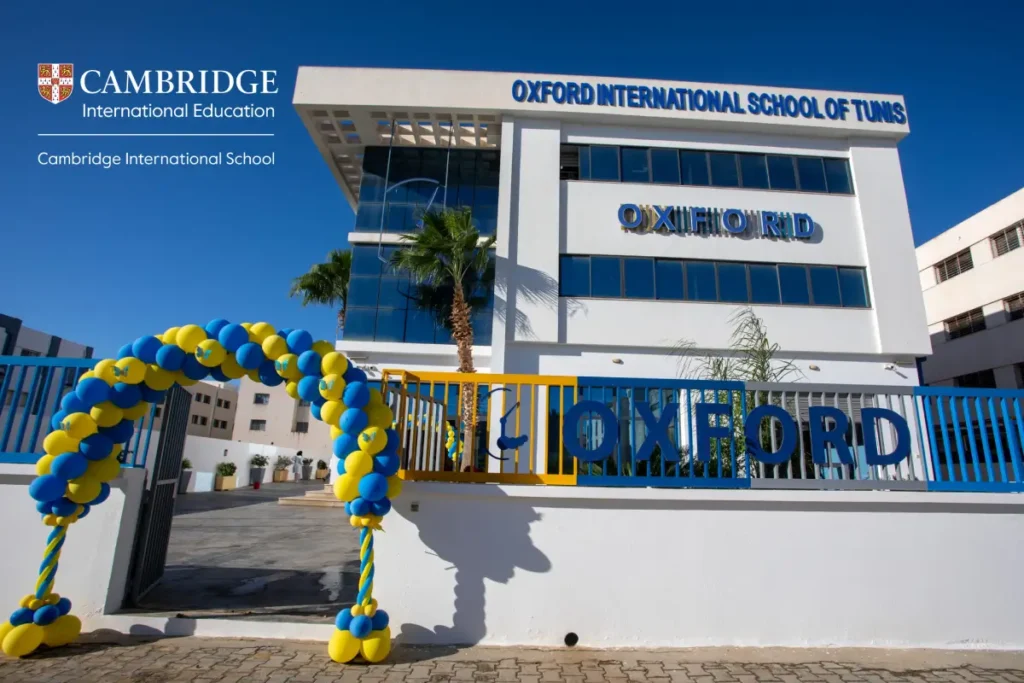
At Oxford International School of Tunis (OIST), the Cambridge pathway forms the foundation of an English-medium international education in Tunis.
This guide explains what the Cambridge curriculum is, how the different stages work and what Tunisian and international families should consider when choosing a Cambridge school in Tunisia.
What Is the Cambridge Curriculum?
The Cambridge curriculum is part of Cambridge International Education, an international education system designed for learners from early years through pre-university education.
Rather than being a single programme for one age group, Cambridge offers a five-stage Cambridge Pathway:
Cambridge Early Years → Cambridge Primary → Cambridge Lower Secondary → Cambridge Upper Secondary → Cambridge Advanced
The pathway is designed for students from approximately age 3 to 19, with each stage developing the knowledge, understanding and skills acquired at the previous stage. Schools can offer individual stages or a longer continuous pathway.
The Cambridge approach places importance on:
- Strong subject knowledge
- Conceptual understanding
- Critical thinking
- Problem-solving
- Independent learning
- Communication
- International perspectives
- Appropriate and reliable assessment
For families, this means the Cambridge curriculum can provide a clear academic structure while maintaining flexibility in subject choice and school context.
How the Cambridge Pathway Works from Age 3 to 19
One of the main advantages of the Cambridge system is its progression.
Instead of viewing Early Years, Primary, Secondary and pre-university education as completely separate stages, the Cambridge Pathway connects them into a longer educational journey.
| Stage | Typical age | Focus |
|---|---|---|
| Cambridge Early Years | 3+ | Early development and foundations |
| Cambridge Primary | 5+ | Core knowledge and learning skills |
| Cambridge Lower Secondary | 11+ | Deeper knowledge and independent thinking |
| Cambridge Upper Secondary / IGCSE | 14+ | Subject depth and international qualifications |
| Cambridge Advanced / A Levels | 16+ | Specialised study and university preparation |
These age ranges are typical rather than rigid rules, and individual schools determine their own programme structure and placement policies.
At OIST, families can explore a pathway that develops progressively from the early years towards Cambridge IGCSE and Cambridge International AS & A Levels.
Cambridge Early Years
Building the Foundations for Learning
Cambridge Early Years is designed for young learners from approximately age 3 and provides a holistic, child-centred approach to early education.
At OIST, the Early Years environment focuses on helping children develop through:
- Exploration
- Communication
- Early literacy
- Early mathematics
- Social and emotional development
- Physical development
- Creative experiences
- Understanding the world around them
The objective at this stage is not to rush children into formal academic learning.
It is to help them develop the confidence, curiosity and foundational skills that support their next stage of education.
Cambridge Primary
Where Strong Foundations Become Confident Futures
Cambridge Primary is typically designed for learners from approximately age 5.
It provides a broad and adaptable curriculum covering core areas including English, Mathematics and Science, alongside other subjects depending on the school’s programme. Cambridge describes the stage as offering flexible assessment options and resources designed to support learning and understand student potential.
At OIST, Cambridge Primary students progressively develop:
- Literacy
- Numeracy
- Scientific understanding
- Digital skills
- Communication
- Problem-solving
- Creativity
- Collaboration
- Independent learning
For families searching for a Cambridge Primary school in Tunisia, the primary years are an important opportunity to establish strong academic habits while maintaining curiosity and enjoyment in learning.
Cambridge Lower Secondary
From Learning Foundations to Independent Thinking
Cambridge Lower Secondary is typically for students from approximately age 11.
It builds on Primary learning while introducing greater academic depth and increasing expectations for independent thinking.
Cambridge Lower Secondary includes a broad range of subjects, with English, Mathematics and Science among the core areas, and provides flexible assessment options.
At OIST, students begin preparing for the more specialised academic demands of Upper Secondary education.
They develop their ability to:
- Analyse information
- Apply knowledge
- Solve problems
- Communicate ideas
- Work independently
- Reflect on their learning
This stage provides an important bridge towards Cambridge IGCSE.
Explore Cambridge Lower Secondary
Cambridge IGCSE
Developing Knowledge, Analysis and Academic Confidence
Cambridge IGCSE forms part of Cambridge Upper Secondary and is typically taken by students aged 14 to 16.
Cambridge IGCSE offers a particularly broad subject choice, with more than 70 subjects available internationally. Students can take different combinations according to the school’s programme and their academic pathway.
The programme encourages students to move beyond memorisation and develop:
- Subject knowledge
- Application of knowledge
- Intellectual enquiry
- Creative thinking
- Problem-solving
- Analytical skills
- Communication
- Cultural awareness
Assessment varies by subject and can include written, oral, coursework and practical components where appropriate.
Cambridge IGCSE qualifications are widely recognised by higher education institutions and employers internationally; however, university entry requirements vary by country, institution and programme.
For families looking for Cambridge IGCSE in Tunisia, it is important to look not only at the qualification itself, but also at the subjects offered, teaching environment, academic support and progression available after IGCSE.
Cambridge International A Levels
The Final Cambridge Stage Before University
Cambridge International AS & A Levels form part of Cambridge Advanced, typically serving students from age 16 onwards.
This stage allows students to move towards more specialised academic study.
Cambridge offers a wide range of AS & A Level subjects internationally, allowing students to build combinations connected to their academic interests and future plans.
At OIST, A Level students develop:
- Deeper subject knowledge
- Analytical thinking
- Independent study
- Research skills
- Academic communication
- Advanced problem-solving
- Greater responsibility for their learning
Cambridge International AS & A Levels are recognised by universities internationally, including all UK universities, while individual institutions and countries may have their own entry requirements.
For students considering higher education in Tunisia, the UK, Europe, North America or elsewhere, understanding the specific admission requirements of their target universities remains essential.
What Do Students Learn?
A Cambridge education is not only about completing a syllabus.
Across the pathway, students progressively develop knowledge and the ability to use that knowledge effectively.
Depending on the stage and subjects studied, students learn to:
Think Critically
Examine information, consider different perspectives and develop reasoned conclusions.
Solve Problems
Apply knowledge to questions and situations that may not have straightforward answers.
Communicate
Express ideas clearly through written, spoken and subject-specific communication.
Work Independently
Take increasing responsibility for organisation, preparation and learning.
Apply Knowledge
Move beyond memorising information and use concepts in familiar and unfamiliar contexts.
Develop Academic Confidence
Build the knowledge and skills required for increasingly demanding academic stages.
This progression is particularly important as students move from Primary education towards IGCSE and A Levels.
How Does Cambridge Assessment Work?
Assessment changes according to the educational stage and subject.
Cambridge provides different assessment approaches throughout the pathway, including progress assessments and formal examinations.
For example, Cambridge Primary and Lower Secondary can include progression and Checkpoint assessments, while Upper Secondary and Advanced qualifications use subject-specific assessment approaches.
At IGCSE and A Level, assessment can include different methods depending on the subject, such as:
- Written examinations
- Practical assessments
- Oral assessments
- Coursework
- Other subject-specific assessment components
The purpose is to measure what students have learned and, depending on the assessment, their ability to apply knowledge and demonstrate relevant skills.
Important for parents: assessment requirements and examination structures can change by syllabus and academic year, so families should always confirm the current arrangements with the school and Cambridge.
Why Do Families Choose Cambridge Education?
For many international and Tunisian families, the appeal of Cambridge education comes from the combination of structure, flexibility and international recognition.
A Clear Educational Pathway
Students can progress through five connected stages from Early Years to Advanced education.
Broad Subject Choice
Cambridge provides a wide range of subjects, particularly at IGCSE and A Level, allowing schools to build programmes around their students.
International Recognition
Cambridge qualifications are recognised by universities and institutions around the world. Cambridge states that more than 2,670 universities in 99 countries formally recognise Cambridge qualifications, although recognition and admission requirements should always be checked with the individual institution.
Focus on Higher-Order Thinking
Cambridge IGCSE, for example, explicitly develops enquiry, creative thinking, problem-solving and the application of knowledge.
International Learning Environment
Cambridge schools form part of a global education community, while schools retain flexibility to shape their curriculum around their own context and students.
Cambridge Curriculum vs Traditional Schooling
The choice is not simply about whether one curriculum is “better” than another.
Parents should consider which educational model fits their child’s needs, learning style and future plans.
A Cambridge international pathway can be particularly attractive to families who value:
International qualifications
A pathway designed for students who may eventually study across different countries.
English-medium education
Useful for families seeking an academic environment where English is central to learning.
Progressive academic structure
Clear stages from early education through pre-university study.
Subject flexibility
A broad range of subjects becomes available as students progress.
Future mobility
Cambridge qualifications are recognised internationally, although university admission requirements vary.
For families in Tunisia, the right choice should ultimately be based on the school’s actual programme, teachers, student support, facilities, admissions requirements and educational environment, not simply the curriculum name.
Is Cambridge Education Suitable for Your Child?
There is no universal answer.
Cambridge education may be worth considering if your family is looking for:
- An international educational pathway
- English-medium academic learning
- Progressive development from Early Years to secondary education
- Strong academic foundations
- International qualifications
- A pathway towards IGCSE and A Levels
- Potential international university progression
But parents should also ask practical questions:
What subjects does the school actually offer?
Which Cambridge stages are available?
How are students assessed?
What support is available if a student struggles academically?
How does the school handle transitions between stages?
What are the school’s admissions and placement requirements?
What are the university pathways available after A Levels?
A school visit and conversation with the admissions or academic team can often answer these questions better than a brochure alone.
Cambridge Schools in Tunisia
Families searching for a Cambridge school in Tunisia will find several international and private schools offering Cambridge programmes.
However, schools can differ significantly in:
- Cambridge stages offered
- Subjects available
- English-medium provision
- School location
- Student support
- Facilities
- Extracurricular opportunities
- Examination arrangements
- Admissions policies
- University preparation
This is why comparing schools should go beyond simply searching for the phrase “Cambridge curriculum in Tunisia.”
Parents should evaluate the complete educational experience offered by each school.
For families specifically looking for a Cambridge international school in Tunis, location is also an important consideration. OIST serves families in the Tunis area and provides an English-medium international learning environment.
The Cambridge Pathway at Oxford International School of Tunis
At Oxford International School of Tunis, the Cambridge pathway provides a framework for students to progress through different stages of their education.
Early Years
Explore → Discover → Build Foundations
Cambridge Primary
Learn → Develop → Gain Confidence
Cambridge Lower Secondary
Analyse → Apply → Become More Independent
Cambridge IGCSE
Deepen Knowledge → Think Critically → Prepare for the Next Stage
Cambridge International A Levels
Specialise → Analyse → Prepare for University
The objective is not simply to move students from one examination to another.
It is to help them progressively develop the knowledge, confidence, independence and academic skills required for the next stage of their education.
Why Choose OIST for a Cambridge Education in Tunisia?
At OIST, families can explore an international education built around several key principles:
English-Medium Learning
Students learn and communicate within an English-medium academic environment.
Cambridge Pathway
A progression from Early Years through Primary, Lower Secondary, IGCSE and A Levels.
Student-Centred Education
Academic development is combined with attention to confidence, independence and personal growth.
International Perspective
Students encounter different ideas, languages, cultures and perspectives within an international school environment.
Beyond the Classroom
Arts, music, drama, sports, robotics, clubs and educational activities complement academic learning.
Preparation for the Future
The Cambridge pathway provides a foundation for students progressing towards higher education and future academic opportunities.
[Discover Why Families Choose OIST →]
Frequently Asked Questions About the Cambridge Curriculum in Tunisia
What is the Cambridge curriculum?
The Cambridge curriculum is a group of international education programmes and qualifications covering the Cambridge Pathway from approximately age 3 to 19. It includes Early Years, Primary, Lower Secondary, Upper Secondary and Advanced stages.
Is Cambridge available in Tunisia?
Yes. Cambridge programmes and qualifications are offered by international and private schools in Tunisia. Families should compare the specific stages, subjects and educational services offered by each school.
What age does the Cambridge curriculum start?
The Cambridge Pathway begins with Cambridge Early Years at approximately age 3. Cambridge Primary typically starts at age 5, followed by Lower Secondary from around age 11, Upper Secondary from around age 14 and Cambridge Advanced from around age 16.
What is Cambridge IGCSE?
Cambridge IGCSE is an international qualification typically taken by students aged 14–16. Cambridge offers more than 70 IGCSE subjects internationally, with each subject certificated separately.
What comes after Cambridge IGCSE?
Students can progress to Cambridge International AS & A Levels, which form part of the Cambridge Advanced stage.
Are Cambridge IGCSE and A Levels recognised internationally?
Cambridge states that its qualifications are recognised by universities around the world. However, individual universities and countries establish their own admission requirements, so students should verify the requirements for their intended university and degree programme.
Is Cambridge suitable for students who want to study abroad?
It can be. Cambridge qualifications are designed for international education and are recognised by universities in many countries. Students should nevertheless check the exact entry requirements of their intended universities before selecting subjects and qualifications.
Does OIST offer the complete Cambridge pathway?
OIST’s educational pathway covers Early Years, Cambridge Primary, Cambridge Lower Secondary, Cambridge IGCSE and Cambridge International AS & A Levels. Families should contact OIST to confirm the current programme and subject availability for the relevant academic year.
Find the Right Cambridge Programme for Your Child
Your child’s age is only the beginning.
Their current school year, academic background, language skills, interests and future plans can all influence the most appropriate educational pathway.
Not sure which Cambridge programme is right for your child?
Tell us your child’s age and current year group.
Our admissions team can help you understand the relevant OIST programme, placement process and next steps.