








Early Years School in Tunis | Cambridge Early Years | OIST
Discover Early Years at Oxford International School of Tunis. An English-medium, child-centred learning environment in Tunis where young children build confidence, curiosity and essential foundations.
Cambridge Early Years School in Tunis
A Confident Start for Curious Young Learners
The first years of school are not simply about preparing children for the next classroom.
They are about helping them discover that learning can be exciting.
At Oxford International School of Tunis (OIST), our Early Years programme provides a supportive, English-medium environment where young children can explore, communicate, build relationships and develop confidence through meaningful learning experiences.
Based in the Tunis area, OIST welcomes families looking for an international education pathway that can support their child’s journey from the early years through Cambridge Primary, IGCSE and A Levels.
Explore. Learn. Grow.
Program Highlight
Age
3+ Years
Curriculum
Cambridge
Learning
Play-Based
Language
English
OVERVIEW
A Strong Beginning for Your Child's Educational Journey
Every child starts school with a different personality, level of confidence and way of discovering the world.
Some children immediately ask questions.
Others prefer to observe first.
Some enjoy working with others.
Others need time before stepping outside their comfort zone.
At OIST, we believe the early years should give children the space to develop at their own pace while gradually building the foundations needed for future learning.
Our role is not simply to introduce children to school.
It is to help them feel confident being part of it.
Early Years at a Glance
Learning Environment
- An English-medium international school environment designed for young learners.
Educational Pathway
- The beginning of a journey that can continue through Cambridge Primary, Lower Secondary, IGCSE and A Levels.
Learning Approach
- Age-appropriate learning through exploration, interaction, communication and structured activities.
Beyond the Classroom
- Young learners can participate in activities that support social, emotional and physical development.
Daily Experience
- The Early Years schedule includes learning activities, outdoor experiences and designated snack times.
The Cambridge Early Years Curriculum at OIST
Cambridge Early Years is part of the wider Cambridge Pathway, which provides a progression through different stages of education.
The Early Years stage focuses on supporting young children’s development through a holistic and engaging learning experience.
At OIST, children are introduced to learning through activities designed to encourage exploration, communication, creativity and personal development.
The Cambridge Early Years framework includes six key curriculum areas.
What will my Child Learn in Early Years at Oxford International School of Tunis.
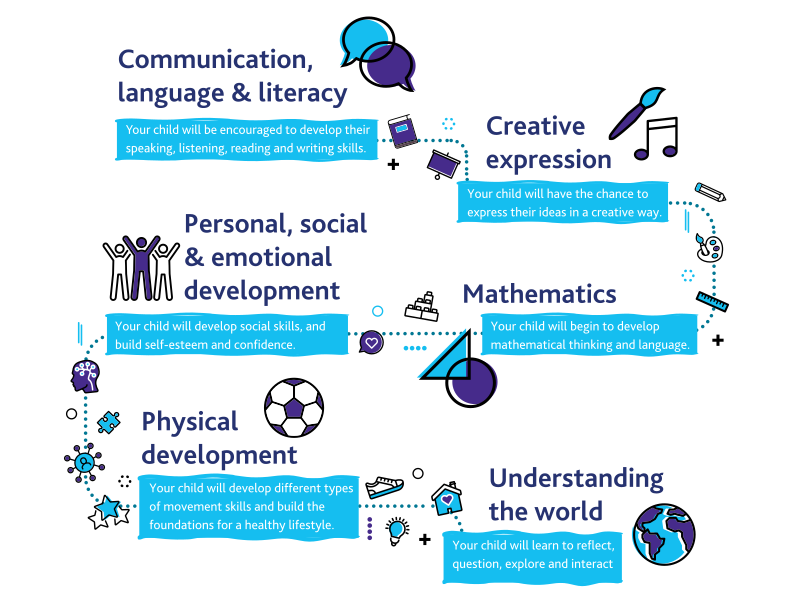
Communication & Literacy
Finding Their Voice
Children begin developing their ability to listen, communicate and engage with language.
Through stories, conversations and age-appropriate activities, they gradually build the confidence to express ideas and interact with the people around them.
English as a Second Language
Growing Confidence in English
For children developing their English language skills, the school environment provides opportunities to hear, understand and use English through everyday learning and interaction.
The focus is on participation and communication rather than simply memorising words.
Mathematics
Discovering Numbers Through Exploration
Early mathematical understanding develops through patterns, numbers, shapes, quantities and problem-solving.
Children begin exploring mathematical ideas through activities that make learning meaningful and engaging.
Physical Development
Moving, Exploring and Growing
Physical activity plays an important role in early childhood development.
Through movement and outdoor experiences, children can develop coordination, confidence and increasing awareness of their own abilities.
Personal, Social & Emotional Development
Learning About Themselves and Others
Starting school is also a social experience.
Children learn how to communicate, cooperate, share, manage emotions and build relationships.
These experiences help create foundations that support both learning and personal development.
Creative Expression
Imagination Has a Place Here
Creativity allows children to explore ideas in their own way.
Through activities involving art, music, movement and imaginative expression, young learners can experiment, communicate and discover new interests.
Learning Through a Rich and Varied Curriculum
Children experience learning across different subject and activity areas.
The programme may include:
| Subject | Description |
|---|---|
| English & Early Literacy | Developing communication, listening, reading readiness and early language skills. |
| English Phonics | Helping children begin understanding sounds, letters and early reading foundations. |
| Mathematics | Exploring numbers, patterns, shapes and early mathematical thinking. |
| Science & Exploring the World | Encouraging children to observe, question and discover the world around them. |
| Arabic & French | Introducing additional languages as part of a multilingual learning environment. |
| Computing & Technology | Developing early familiarity with technology and digital learning tools through age-appropriate activities. |
| Art & Creativity | Encouraging imagination, creativity and self-expression. |
| Music | Exploring rhythm, sound and creative expression. |
| Drama | Building confidence, communication and imagination through performance and role-play. |
| Physical Education | Supporting movement, coordination and healthy physical development. |
| Personal, Social & Emotional Development | Helping children understand themselves, build relationships and develop positive behaviours. |
How Progress Is Assessed
Young children do not need the pressure of formal high-stakes examinations.
Progress is monitored through observation, classroom activities and ongoing assessment of each child’s development and learning.
At OIST, the assessment system may use the following indicators:
| Indicator | Meaning |
|---|---|
| E | Excellent |
| G | Good |
| NI | Needs Improving |
| SR | Support Required |
These indicators help teachers and families understand a child’s progress and identify areas where additional support may be beneficial.
Reception: Discovering the Joy of Learning
Reception provides an important transition into school life.
Children are encouraged to explore, communicate and develop independence in a supportive environment where learning is connected to play, creativity and discovery.
Key learning experiences include:
- Early English and phonics.
- Mathematics and problem-solving.
- Exploring the world and early science.
- Arabic and French.
- Music, drama and art.
- Physical development.
- Personal, social and emotional development.
- Age-appropriate technology activities.
Beyond the classroom
The daily schedule can also include:
- Outdoor activities.
- Morning and afternoon snack breaks.
- Creative and social learning experiences.
Year 1: Building Strong Learning Foundations
As children progress into Year 1, learning becomes increasingly structured while remaining engaging and age-appropriate.
Students begin strengthening essential foundations across literacy, numeracy, science and communication.
Areas of learning include:
- English.
- Mathematics.
- Science.
- Arabic.
- French.
- Computing.
- Global Perspectives activities where applicable.
- Physical Education.
- Music.
- Art.
- Drama.
- Personal, social and emotional development.
The focus is on helping students become increasingly confident, curious and independent learners.
Year 2: Growing in Confidence and Independence
Year 2 builds on the foundations developed during the previous years.
Students continue strengthening their academic knowledge while developing greater independence and responsibility for their learning.
Learning may include:
- English.
- Mathematics.
- Science.
- Arabic.
- French.
- Computing.
- Global Perspectives activities where applicable.
- Physical Education.
- Music.
- Art.
- Drama.
- Personal, social and emotional development.
Students may also participate in quiet reading sessions, helping them develop positive reading habits and greater confidence with independent learning.
Every Family's Educational Journey Is Different
Choosing an international school involves more than selecting a programme.
The appropriate year group, admissions stage and individual educational pathway can influence the information relevant to your child’s enrolment.
For this reason, OIST provides families with personalised admissions and fee information based on their child’s profile and intended entry level.
Rather than displaying a generic price, we invite you to request a personalised cost estimate.
This allows our Admissions team to provide information relevant to:
- Your child’s intended year group.
- The programme or stage they are applying for.
- Applicable school and enrolment requirements.
- The academic year of entry.
- Any additional information relevant to the application.
Complete a short form and our Admissions team can provide the relevant information for your child's intended entry.
Our program costs are designed to remain transparent competitive and accessible for students from diverse backgrounds. Each academic program includes tuition fees, registration charges and essential learning resources ensuring students receive high-quality education and comprehensive academic support Costs may vary based on program type, course load, and mode of study (on-campus, hybrid, or online) We aim to provide exceptional value through modern facilities, expert faculty, and industry aligned curriculum making your investment in education both meaningful and future-focused.
Personal Information
Admissions to Early Years at OIST
A Clear Process for Families
Applying to a new school is an important step for both parents and children.
At OIST, the admissions process is designed to help the school understand each applicant and determine the most appropriate placement.
Admission decisions are based on several factors, including age appropriateness, academic readiness where applicable, behavioural suitability and the availability of places.
Who Can Apply?
OIST considers applications from students who meet the school’s admissions criteria.
1. Age-Appropriate Placement
Students are generally placed according to their age as of 1 September of the current academic year, following the school’s year placement framework.
Previous educational records, academic ability, social development and placement assessments may also be considered where appropriate.
2. Readiness for the Programme
Students should demonstrate the level of readiness appropriate for the programme they are applying to.
For younger children, the admissions process takes into account their age and developmental stage.
3. Positive Participation in the School Community
Students are expected to adapt to the school’s rules and contribute positively to the OIST learning environment.
How to Apply to OIST ?
Step 1 — Prepare Your Documents
Before starting your application, make sure you have the required documents available.
For Early Years and KS1 applicants, families may be asked to provide:
- A copy of the student’s passport information page.
- A copy of each parent’s passport information page.
- A passport-sized photograph of the student.
- Passport-sized photographs of parents or guardians.
- A completed student medical form.
- A copy of the student’s immunisation record.
- Previous academic records, where applicable.
Step 2 — Submit Your Application
Complete the OIST application form and submit the required documentation.
Families are responsible for ensuring that the information and documents provided are complete and accurate.
Incomplete, falsified or omitted information may affect the application.
Step 3 — Assessment Fee
A non-refundable assessment fee of 50 TND per student is required for an application to be considered.
Once the required application information, school records where applicable and assessment fee have been received, the admissions process can continue.
Step 4 — Assessment and Placement
Depending on the student’s age and stage of entry, applicants may be asked to participate in an admissions assessment or interview.
The purpose of this stage is to help OIST understand the student’s educational background, abilities and suitability for the programme.
For older applicants, assessments may include areas such as:
- English language proficiency.
- Mathematics.
- Academic readiness.
Additional assessment may be required where English language support or academic support needs to be considered.
For younger applicants, the process is adapted to their age and developmental stage.
Step 5 — Admission Decision
Admission decisions are made on a rolling basis and may take into account:
- The student’s age and educational background.
- Academic records.
- Assessment results, where required.
- Interview performance, where applicable.
- Available places in the requested year group.
Admission decisions and placement are determined by the school administration.
Step 6 — Official Enrolment
Once a place is offered, parents or guardians complete the enrolment process.
This may include:
- Submission of the remaining required documentation.
- Payment of applicable enrolment fees.
- Acceptance of the school’s terms and conditions.
- Signing the Student Commitment Letter.
- Signing the Home/School Agreement.
- Signing the Family Commitment and required financial documents.
Once the required process has been completed, the family receives the necessary enrolment and financial information from the relevant school departments.
Start Your Application
Let's Find the Right Starting Point for Your Child
Every child's educational journey is different.
Whether your child is beginning their first school experience or joining OIST from another educational environment, our Admissions team can help guide you through the appropriate next steps.