





Cambridge Lower Secondary School in Tunis | OIST
Discover Cambridge Lower Secondary at Oxford International School of Tunis. An English-medium programme in Tunis preparing students for IGCSE through deeper learning, independence and academic growth.
Cambridge Lower Secondary School in Tunis
Building Confident, Independent and Capable Learners
The transition into secondary school is an important stage in every student’s educational journey.
It is a time when learners begin to explore subjects in greater depth, develop stronger academic skills and become increasingly independent in the way they think, learn and approach new challenges.
At Oxford International School of Tunis (OIST), our Cambridge Lower Secondary programme provides students aged approximately 11 to 14 with a structured and internationally recognised educational pathway.
Through engaging teaching, a broad curriculum and supportive learning environment, students develop the knowledge, confidence and critical-thinking skills needed for the next stage of their Cambridge education.
Based in the Tunis area, OIST offers families an English-medium international education pathway that can continue from Cambridge Primary through Lower Secondary, IGCSE and A Levels.
Think. Explore. Progress.
Program Highlight
Age
11–14 Years
Curriculum
Cambridge
Focus
Deeper Learning
Language
English
OVERVIEW
A Strong Foundation for the Next Stage of Learning
Every student enters Lower Secondary with different strengths, interests and ways of learning.
Some are naturally confident when expressing their ideas.
Others excel at analysing problems and finding solutions.
Some discover a passion for science, technology or mathematics.
Others develop their strengths through languages, creativity or global perspectives.
At OIST, we believe that Lower Secondary education should help students discover where their strengths lie while giving them the knowledge and support to continue developing.
Our role is not simply to prepare students for examinations.
It is to help them become confident, independent and responsible learners.
During Years 7, 8 and 9, students build on the foundations developed in primary school while gradually preparing for the academic expectations of IGCSE and the later stages of the Cambridge Pathway.
They learn to ask better questions.
To analyse information.
To communicate their ideas.
And to approach challenges with greater independence.
Lower Secondary at a Glance
Learning Environment
- An English-medium international school environment where students learn, collaborate, question and develop confidence in their academic abilities.
Educational Pathway
- A clear progression through Year 7, Year 8 and Year 9, preparing students for Cambridge IGCSE and the next stages of international education.
Learning Approach
- Age-appropriate learning that combines subject knowledge, critical thinking, practical activities, discussion and independent learning.
Beyond the Classroom
- Students can participate in activities, projects, events and clubs that support creativity, teamwork, leadership and personal development.
Assessment and Progress
- Optional Cambridge assessments help schools measure student progress and provide valuable insight into areas of strength and future development.
The Cambridge Early Years Curriculum at OIST
A Broad Cambridge Curriculum for Developing Minds
Cambridge Lower Secondary provides students with a broad and flexible curriculum designed for learners aged approximately 11 to 14.
The programme offers a choice of more than ten subjects, allowing students to build strong foundations in essential academic areas while also developing creativity, communication, expression and personal wellbeing.
At OIST, students follow a structured educational programme that helps them progress through the key academic skills needed for the next stage of their Cambridge journey.
Core areas such as English, Mathematics and Science provide essential foundations, while additional subjects encourage students to explore new interests and develop a broader understanding of the world around them.
The curriculum is designed not only around what students learn.
But also around how they learn.
Students are encouraged to think critically, solve problems, communicate effectively and gradually take greater responsibility for their own learning.
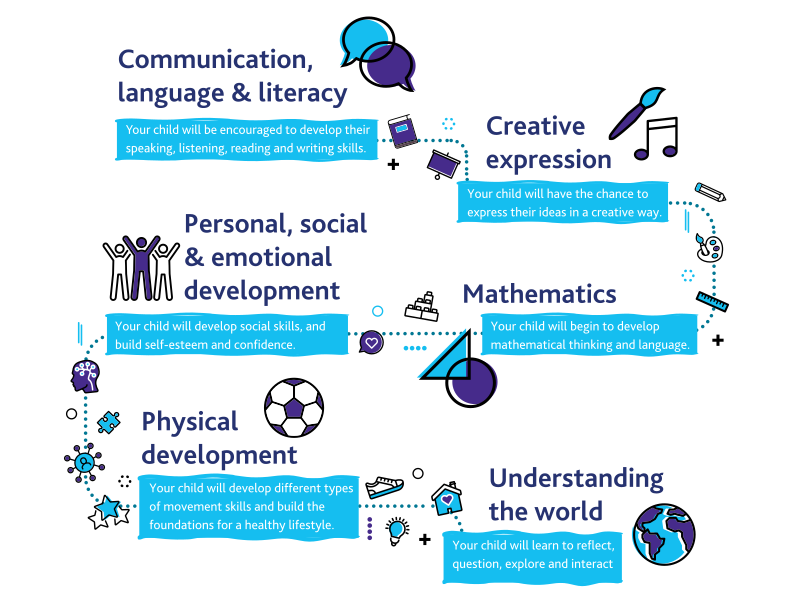
What will my Child Learn in Early Years at Oxford International School of Tunis.
English
English develops students' ability to read critically, write clearly and communicate confidently.
Through literature, language and a variety of written and spoken activities, learners strengthen their analytical skills and learn how to express ideas effectively for different audiences and purposes.
Mathematics
Mathematics develops logical thinking, problem-solving and confidence in working with numbers, patterns and mathematical relationships.
Students build a deeper understanding of mathematical concepts while learning how to apply their knowledge to increasingly complex problems and real-world situations.
Science
Science encourages students to investigate, question and understand the world through scientific thinking and practical exploration.
By developing knowledge across key scientific areas, learners strengthen their ability to observe, analyse evidence, test ideas and communicate scientific conclusions.
Cambridge Global Perspectives
Cambridge Global Perspectives encourages students to explore important local and global issues from different viewpoints.
Through research, discussion and collaborative projects, learners develop critical thinking, communication, reflection and problem-solving skills that support both academic and personal growth.
Computing
Computing helps students develop the digital knowledge and logical thinking needed in an increasingly technology-driven world.
Learners explore computational thinking, programming and digital systems while developing problem-solving skills and a deeper understanding of how technology can be used responsibly and effectively.
Languages
Language learning helps students communicate across cultures and develop a broader understanding of the world.
Through reading, writing, listening and speaking activities, students build confidence in expressing ideas while strengthening the communication skills needed for an international learning environment.
Creative and Expressive Learning
Creative subjects give students opportunities to explore ideas, develop imagination and express themselves in different ways.
Through practical activities and projects, learners build confidence, creativity and the ability to communicate their perspectives beyond traditional academic subjects.
Physical Education
Physical Education supports students' physical development while promoting teamwork, discipline, resilience and an active lifestyle.
Through sport and structured physical activities, learners develop confidence, cooperation and a greater understanding of personal wellbeing.
LEARNING EXPERIENCE
More Than Preparing for the Next Exam
Academic progress is an important part of Lower Secondary education.
But it is not the only measure of success.
At OIST, students are encouraged to develop the skills that will support them throughout the rest of their education.
They learn how to organise their work.
How to research information.
How to evaluate different ideas.
How to collaborate with others.
And how to become increasingly independent learners.
As students progress through Years 7, 8 and 9, they gradually build the academic maturity and confidence needed to make the transition towards Cambridge IGCSE.
ASSESSMENT
Understanding Progress and Preparing for What Comes Next
Assessment helps students, teachers and families understand how learning is progressing.
Throughout Cambridge Lower Secondary, students can be assessed through classroom activities and optional Cambridge assessments that provide insight into their knowledge, skills and areas for development.
At the end of Lower Secondary, eligible students may sit Cambridge Lower Secondary Checkpoint assessments.
These internationally recognised assessments can cover selected subjects, including English or English as a Second Language, Mathematics, Science and Cambridge Global Perspectives, depending on the subjects offered and assessment choices.
The results help provide a clearer picture of student progress and support the transition towards the next stage of the Cambridge Pathway.
BEYOND THE CLASSROOM
Learning Through Experiences, Leadership and Discovery
Education does not stop when the lesson ends.
At Oxford International School of Tunis, Lower Secondary students can take part in experiences that encourage curiosity, creativity, teamwork and leadership.
Educational trips help students connect classroom learning with the world around them.
School events and activities create opportunities to collaborate, communicate and take part in the wider school community.
Students can also explore their interests through activities such as robotics, science projects and other creative or collaborative initiatives.
Opportunities for student representation and leadership help learners take greater responsibility, contribute to school life and develop the confidence to share their ideas.
These experiences complement academic learning and help students develop skills that extend far beyond the classroom.
YOUR CHILD’S NEXT STEP
From Cambridge Primary to a Future Without Limits
Cambridge Lower Secondary represents an important bridge between the foundations of primary education and the increased academic independence of IGCSE.
At OIST, we support students throughout this transition by providing a structured curriculum, an international learning environment and opportunities to develop both academically and personally.
The journey continues.
Learn with confidence. Think independently. Prepare for what comes next.
Every Family's Educational Journey Is Different
Choosing an international school involves more than selecting a programme.
The appropriate year group, admissions stage and individual educational pathway can influence the information relevant to your child’s enrolment.
For this reason, OIST provides families with personalised admissions and fee information based on their child’s profile and intended entry level.
Rather than displaying a generic price, we invite you to request a personalised cost estimate.
This allows our Admissions team to provide information relevant to:
- Your child’s intended year group.
- The programme or stage they are applying for.
- Applicable school and enrolment requirements.
- The academic year of entry.
- Any additional information relevant to the application.
Complete a short form and our Admissions team can provide the relevant information for your child's intended entry.
Our program costs are designed to remain transparent competitive and accessible for students from diverse backgrounds. Each academic program includes tuition fees, registration charges and essential learning resources ensuring students receive high-quality education and comprehensive academic support Costs may vary based on program type, course load, and mode of study (on-campus, hybrid, or online) We aim to provide exceptional value through modern facilities, expert faculty, and industry aligned curriculum making your investment in education both meaningful and future-focused.
Personal Information
Admissions to Cambridge Lower Secondary School in Tunisia at OIST
A Clear Process for Families
Applying to a new school is an important step for both parents and children.
At OIST, the admissions process is designed to help the school understand each applicant and determine the most appropriate placement.
Admission decisions are based on several factors, including age appropriateness, academic readiness where applicable, behavioural suitability and the availability of places.
Who Can Apply?
OIST considers applications from students who meet the school’s admissions criteria.
1. Age-Appropriate Placement
Students are generally placed according to their age as of 1 September of the current academic year, following the school’s year placement framework.
Previous educational records, academic ability, social development and placement assessments may also be considered where appropriate.
2. Readiness for the Programme
Students should demonstrate the level of readiness appropriate for the programme they are applying to.
For younger children, the admissions process takes into account their age and developmental stage.
3. Positive Participation in the School Community
Students are expected to adapt to the school’s rules and contribute positively to the OIST learning environment.
How to Apply to OIST ?
Step 1 — Prepare Your Documents
Before starting your application, make sure you have the required documents available.
For Cambridge Lower Secondary School in Tunis applicants, families may be asked to provide:
- A copy of the student’s passport information page.
- A copy of each parent’s passport information page.
- A passport-sized photograph of the student.
- Passport-sized photographs of parents or guardians.
- A completed student medical form.
- A copy of the student’s immunisation record.
- Previous academic records, where applicable.
Step 2 — Submit Your Application
Complete the OIST application form and submit the required documentation.
Families are responsible for ensuring that the information and documents provided are complete and accurate.
Incomplete, falsified or omitted information may affect the application.
Step 3 — Assessment Fee
A non-refundable assessment fee of 50 TND per student is required for an application to be considered.
Once the required application information, school records where applicable and assessment fee have been received, the admissions process can continue.
Step 4 — Assessment and Placement
Depending on the student’s age and stage of entry, applicants may be asked to participate in an admissions assessment or interview.
The purpose of this stage is to help OIST understand the student’s educational background, abilities and suitability for the programme.
For older applicants, assessments may include areas such as:
- English language proficiency.
- Mathematics.
- Academic readiness.
Additional assessment may be required where English language support or academic support needs to be considered.
For younger applicants, the process is adapted to their age and developmental stage.
Step 5 — Admission Decision
Admission decisions are made on a rolling basis and may take into account:
- The student’s age and educational background.
- Academic records.
- Assessment results, where required.
- Interview performance, where applicable.
- Available places in the requested year group.
Admission decisions and placement are determined by the school administration.
Step 6 — Official Enrolment
Once a place is offered, parents or guardians complete the enrolment process.
This may include:
- Submission of the remaining required documentation.
- Payment of applicable enrolment fees.
- Acceptance of the school’s terms and conditions.
- Signing the Student Commitment Letter.
- Signing the Home/School Agreement.
- Signing the Family Commitment and required financial documents.
Once the required process has been completed, the family receives the necessary enrolment and financial information from the relevant school departments.
Start Your Application
Let's Find the Right Starting Point for Your Child
Every child's educational journey is different.
Whether your child is beginning their first school experience or joining OIST from another educational environment, our Admissions team can help guide you through the appropriate next steps.